Software is principally concerned with abstractions. Instead of writing binary, we have programming languages that abstract away the machine-readable details. Instead of repeating thousands of lines of code to perform some action, we abstract the action as a single function that represents our intent. We are masters of reducing complexity to composable primitives. Abstraction boundaries in software are clean because they are designed to be that way.
The AI gold rush created enormous demand for software across domains that had long resisted automation. Investors and institutions responded by funding multidisciplinary teams of engineers and domain experts. They have no shortage of technical competence, healthy budgets, and viable development timelines, yet they struggle to produce systems that meaningfully reduce complexity in their target domains. Why?
In medicine, abstractions are discovered after the fact, then imposed on a physical system that never agreed to honor them. This fantastic prospect of reducing something as complex as medical diagnosis into a single, neatly-packaged function is too attractive for startups and Fortune 500s alike to ignore. However, increased investment in such systems has done little more than demonstrate how poorly medicine compresses into clean software abstractions.
Spolsky's Law of Leaky Abstractions elegantly captures the root of the problem:
All non-trivial abstractions, to some degree, are leaky.
This "leaky behavior" represents exceptions to the rules, and is by no means limited to software. Analogous mental tools in medicine take the form of heuristics. For example, a patient complains of substernal chest pain, and heuristics dictate this alone justifies a work-up for myocardial infarction. A patient complains of a breast lump and histology reveals a compressed, slit-like duct - you start thinking about fibroadenoma. These are powerful shortcuts in and of themselves, but they don't capture the full nuance. In fact, medical heuristics are especially leaky. The suspected MI? It ended up being costochondritis. That suspected fibroadenoma? It may instead be benign stromal proliferation, with the biopsy sampling just enough compressed duct to suggest the wrong pattern and not enough of the surrounding architecture to reveal the process.
Culturally, medicine and software have radically different attitudes towards abstractions. The leaky behavior in software represents problems that can be solved with more honest mental models. When heuristics fail in medicine, the solution isn't usually to engineer superior replacements. Rather, clinicians accept that they're dealing with an exception and act accordingly. New heuristics that cover edge cases pop up, but they tend to be divorced from the underlying pattern that motivated the original rule. A clinician may learn one heuristic for chest pain, another for atypical presentation in diabetics, another for women, another for elderly patients, another for cocaine use, another for normal initial troponin, and so on. These are not always cleanly composed into a single elegant model. They are operational patches over an incompletely observable system.
At some point, the "how" or "why" takes a back seat to a clinician's mere ability to recognize and act appropriately. This reality is in conflict with the engineering mind's tendency to claw for beautifully composed abstractions capable of being followed down to the mechanisms.
It is not a matter of rigor. Medicine's rich scientific edifice simply doesn't save it from being more of an engineering discipline. I mean engineering in the older sense: bounded decisions under uncertainty, with incomplete measurements, noisy instruments, resource constraints, and failure modes imposed by the physical world. With respect to "abstraction resistance", the mental experience of clinical medicine has more in common with electrical or FPGA engineering than software. This isn't all that surprising given that it deals with a physical system. What is surprising is how much difficulty software engineers - myself included - have in coming to terms with it.
Rest assured this disconnect isn't going anywhere, at least not soon. If it took me multiple years of formal medical education to appreciate the nature (and magnitude) of the problem, I can't assume such an epiphany is imminent for most software engineers.
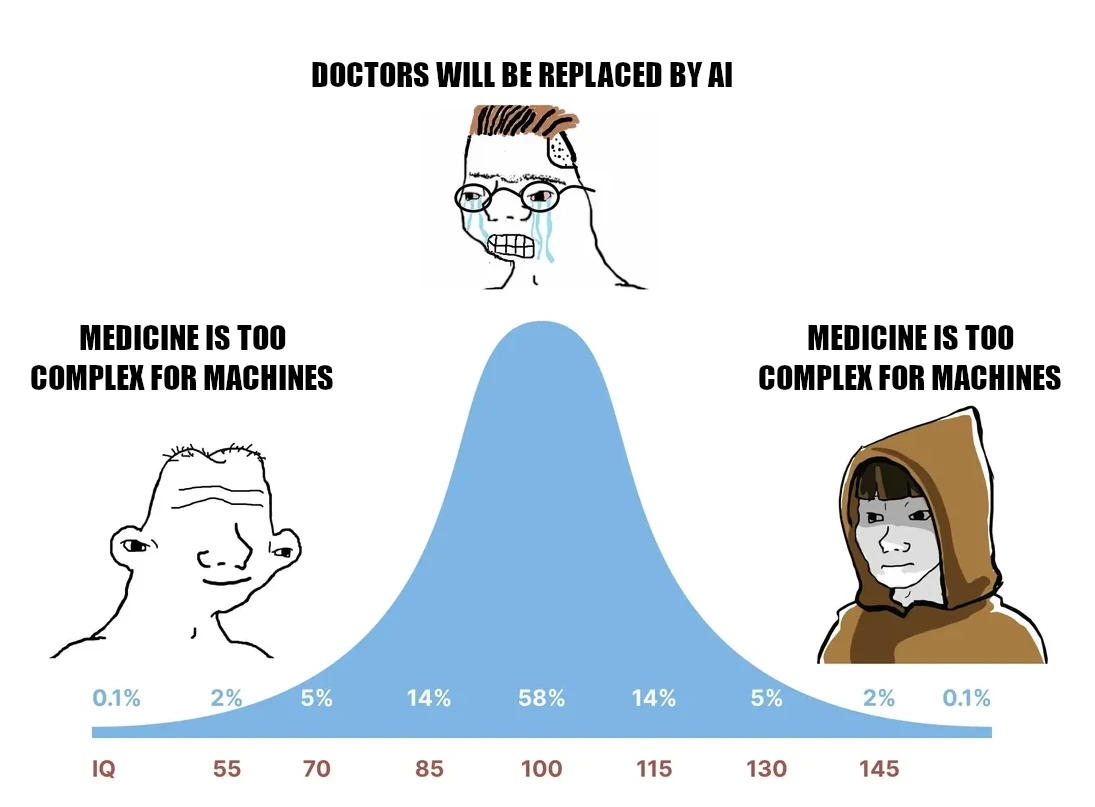
This does not mean medical AI is doomed. It means the useful systems will be the ones that respect the leaks. They will surface uncertainty, preserve context, expose provenance, defer to domain constraints, and help clinicians navigate complexity rather than pretending to erase it. The fantasy is a function called diagnose(patient). The opportunity is software that makes the clinician's incomplete, time-constrained reasoning more visible, testable, and humane.
-Tom